Although we had the same last name, Paco and I were not related.
The first time I saw Paco was in the 2007 cinema guide. The cinema guide was a thick newsletter with photos of actors printed inside. It was an annual catalog with their contact numbers or those of their agencies or representatives. Paco’s photo, in black and white, was of a person with a hard look, reminding me of the days of the Iberian “macho” and the Franco dictatorship. A time I didn’t live through, but whose echoes I knew, especially throughout the 1980s and late 1990s, with stale and strict characters who demanded discipline and ancestry.
Hector Caño and I had finished writing the script for “Instructions for a New Life,” which would be my first feature film, and the protagonist was going to be Jose Luis Ayestaran, a bodybuilder who had been Arnold Schwarzenegger’s stunt double, Supersonic Man in Juan Piquer’s films, and a great friend of Hector’s father.
We wrote the script with Jose Luis in mind, but at the last minute, he backed out. He must have thought it wasn’t serious until he saw us start to set up camp and the filming dates arrived. Then he told us he couldn’t do it. So, a few weeks before shooting was due to start, I found myself with the whole technical team and cast waiting, but without one of the main actors, on whom we had based the main story.
From the photo in the movie guide, I thought Francisco, Paco, could play the part. That tough look was promising. The story of the decline of a dubbing actor might interest him. So I contacted him.
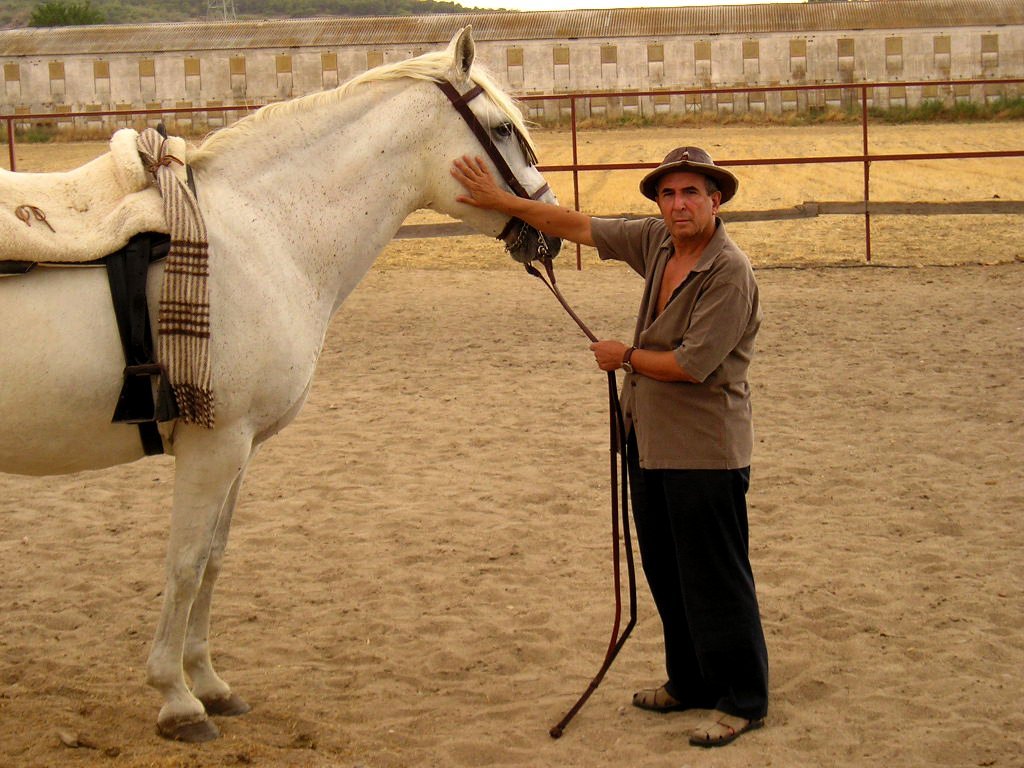
We met at a bar on Galileo Street. Later I found out that he lived right there, across from the theater, and that he had a friendly Labrador retriever. I was surprised by the piles of books stacked on the floor of his apartment, and then I realized that Paco was a cultured man. In that café, I also saw that he was actually a short man, not the tough guy the photo in the movie guide suggested. Paco saw my surprise and told me that if he wasn’t what I expected, it was okay. I then told him that the role was for Jose Luis, who was almost two meters tall and very heavyset. Paco told me he had thought about it and that there were several things we could do. He clearly had everything under control. He made small changes to the character’s lines to adapt them, and as soon as Carla from production took a photo of him with his hat and unbuttoned shirt, we discovered that Paco was incredibly photogenic and had undoubtedly been born to act.
Paco didn’t realize that our film, rather than an independent film, was an underground film made with paper, scissors, and glue sticks. When he arrived at the farm that a friend’s family had lent us in Talavera de la Reina and saw the Boy Scout camp we had set up, he thought I had tricked him. However, when we started shooting, our professionalism and his prevailed over any kind of prejudice. The romanticism of the world of cinema blinds us and pushes us to the end, and that’s how we really got to know each other. As a curiosity, our shoot coincided with that of “Pan’s Labyrinth,” which further emphasized our status as outsiders. In a way, this also had an impact on Paco himself, who experienced the great contrast of participating in our low-budget film that August at the same time as in an international production of the caliber of Guillermo del Toro’s.
I can say that Paco was a great person, a great actor, and above all, a teacher. He was generous with us, and thanks to him, the film grew to become a much more realistic story than it was on paper. I discovered that Paco was not only an actor but also a theater director, that his specialty at the William Layton Institute was improvisation on stage, and that he had been William’s most brilliant student. That actor who had worked on El Crack and Crónicas de un pueblo turned out not to be the tough guy he could appear to be, but quite the opposite: a person of great sensitivity, a true chameleon who could transform himself, a true professional actor.
Paco knew how to give me advice when I was lost. He was the one who staged his sequences. Somehow I know he enjoyed playing “Seymour” in “Instructions…” and I also know that he appreciated our efforts to make a film from scratch.
Truffaut said in an interview, “I am reaching a point in my life where I can no longer watch my films from more than seven or eight years ago. Probably for sentimental reasons. The death of some actors is very upsetting to me“ (”The Film Lesson,” Shangrila Publishing).
When you make a film and create characters, you can’t help but form a very strong relationship with the actors who play them. In a way, actors become immortal in their roles. They stop aging and remain forever as you knew them, as they shaped their characters and were filmed at that moment. And this illusion is confronted with the reality that actors age and die. What remains in your memory is a mixture of the real person who is no longer there and the character, who remains frozen in time. As a viewer, that feeling is not the same, because you don’t know the person who created the character. However, as a director, you have a very personal connection, the emotion that Truffaut refers to, having had a playmate who will never return.
Paco always told me that you had to keep going despite everything. The life of an artist always goes through low points where you don’t have the strength to carry on. In difficult times, I always remember Paco’s words.
Thank you for everything, Paco. Goodbye, maestro ❤️.